Improving on-boarding
The issue
Imperia Borealis is quite a complex game, with a lot of integrated systems. It is therefore important for the game to explain these systems in a clear and intuitive way. To guide the player along.
At the same time, Imperia is designed to be an open-ended game where players set their own goals, using the game systems that they have learned to achieve them.
The challenge then is to, on the one hand, guide the player through the systems of the game and, on the other hand, opening up the sandbox and letting the players try their wings.
One goal has been to design a system that achieves this in a few ways:
- Guide the player through the games different mechanics
- Show the journey to the player and where the designed quest path will lead
- Provide the players with aspirational, open-ended goals once the initial quest chain is completed
The mission board
Taking inspiration from Europa Universalis mission board, we set out to implement a quest roadmap that would fulfill those requirements in a visually clear fashion.
The current quest chain is sorted into their respective category, each such category is represented within a station / panel and shows the players progression along the entire quest chain, explaining both the short term and long term goal of the quest they are currently on. The larger context of what they are currently doing.
At the bottom of the mission board, unlocked once the quest chain is completed, are thematic aspirational goals that the player can work towards. For example, one such goal is to become the master of the Gotland trade that will also help track trading volume such that the player can measure themselves on how well they are hitting the goal currently.
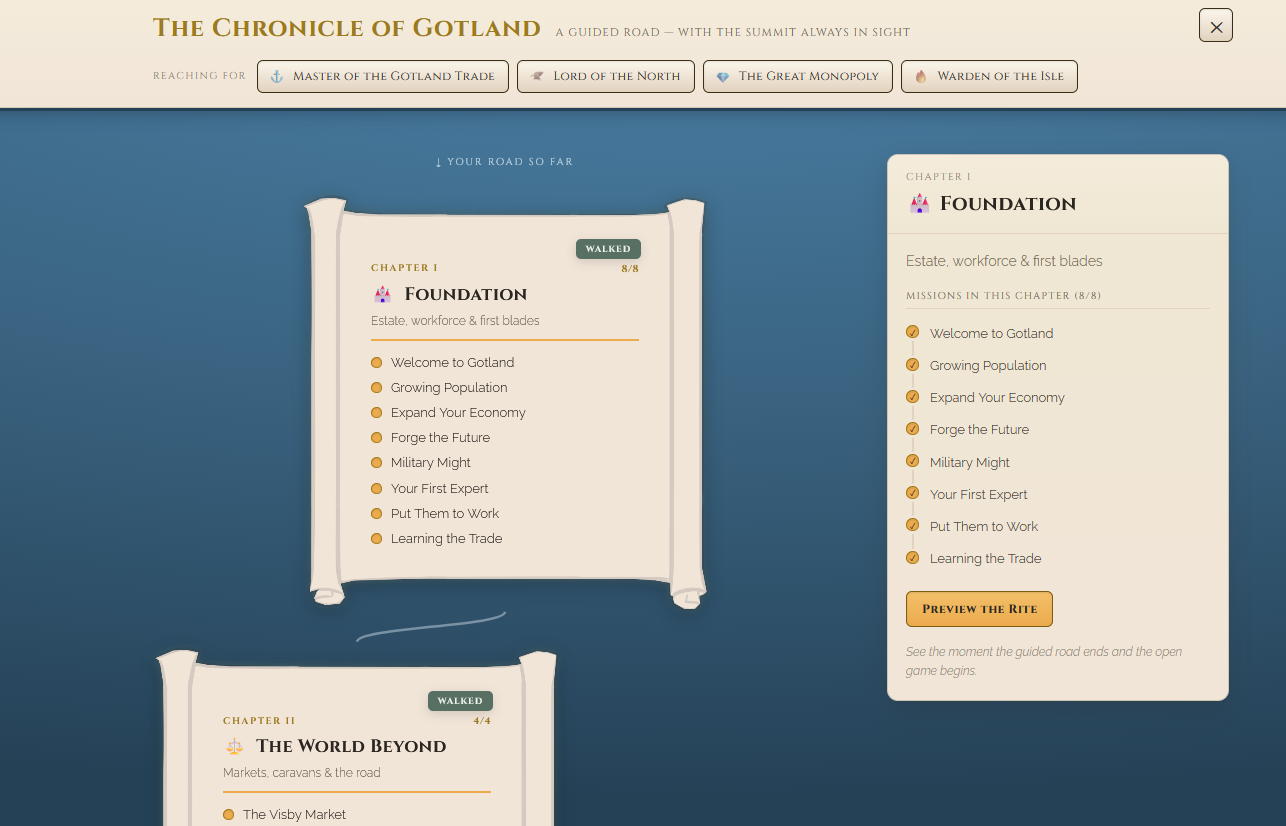
This is an early version of how we want it to look and feel. Don't mind the placeholder art and UTF icons.
The theory
In game design theory this pattern is sometimes described as matrix with Prescribed paths, Open paths, Designed set goals and player set goals as the columns and rows.
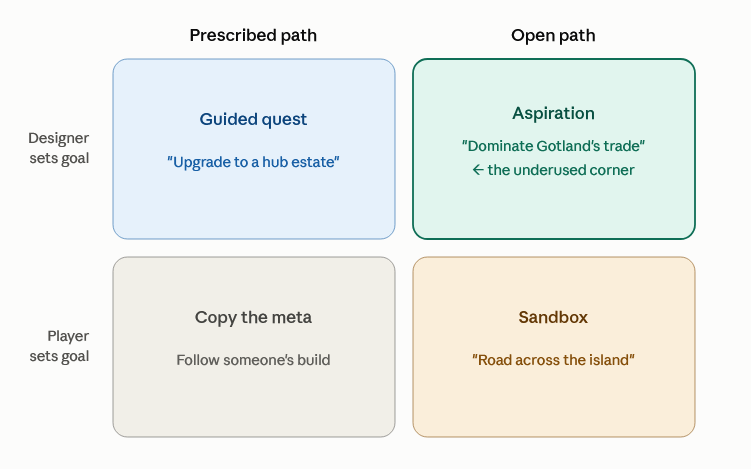
This matrix is not mutually exclusive however, one phase of the game can (and often needs to) be prescribed by the game designer. This is usually done via a tutorial or quest system. A designer forcing a certain path on the player.
But as the player progress and learns more about the game, the game can slowly lift the forcing hand and move into a more open path. One way to do this would be to give the player aspirational goals to reach on their own, without step-by-step guidance.
The other part of the matrix is goals set by the player, not the designer. These are arguably even more important than the designer set goals. These can also be prescribed or open. One example would be building a massive castle in Minecraft, nothing in terms of game progression is really achieved by doing so, the game never guides you towards it, it only matters to the player because they themselves have learned the games mechanics, took a look at them and decided that it would be fun/aspirational to build a castle. Some games live here from the outset, often called sandbox games, my opinion is that the designers hand is important to teach the player about the rules of the game to enhance that sandbox experience.
I am rambling a bit here, but the short version is that we want to guide the player early on and then open up the game for the player to set their own goals.
The end
I hope you found this entry interesting. If you want to try out the current version (without the mission board) you can do so for free at: Imperia Borealis